TULARE WALNUT TREE
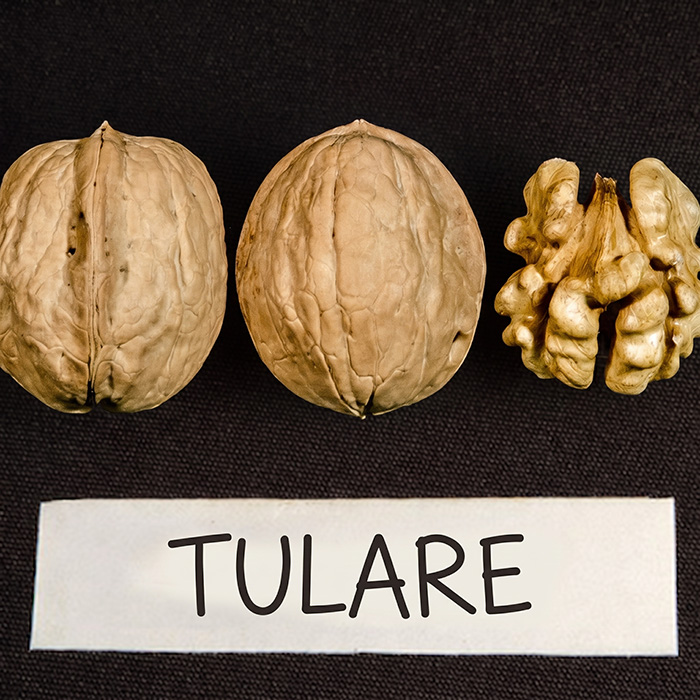
ABOUT TULARE VARIETY
Tulare (Juglans regia 'Tulare') is a large nut, high yielding walnut variety developed by the University of California from a cross of Tehama x Serr. It is a strongly lateral bearing variety, which means it starts producing early and gives high yields in modern high density orchards.
Tulare is best known for three things: a very large, round, well filled nut, an early harvest that comes around ten days before Chandler, and an unusually good overlap between its own male and female flowering, which reduces how much you depend on pollenizer trees.
It is also a proven commercial variety at scale. In the 2021 USDA California walnut acreage survey, Tulare was the second most planted variety in California with 31,085 bearing acres, behind only Chandler, and it is used in modern orchards in Italy. This is not an experimental selection, it is a variety that packing houses and buyers already know.
TULARE AT A GLANCE
- 13.3-14.1
- grams per nut, among the heaviest commercial varieties
- 7.1-7.6
- grams of kernel per nut
- 53%
- kernel percentage
- 2nd
- most planted variety in California, 31,085 bearing acres
- Nut size: Tulare produces a nearly round nut of approximately 36 x 40 mm weighing 13.3-14.1 grams, one of the largest and heaviest among the widely planted commercial varieties. Because it is round rather than oval it also looks big in the shell, which matters in in-shell markets.
- Bearing habit: Tulare is strongly lateral bearing, with around 75-78% of its lateral shoots carrying female flowers. It is also precocious: the first female flowers usually appear in the second year after grafting.
- Yield: In the original Tulare County high density trial, Tulare was the highest yielding variety from the fifth through the eighth leaf, reaching 6,490 to 7,770 kilograms of in-shell walnuts per hectare at approximately 519 trees per hectare.
- Nut and shell quality: The shell is approximately 1.5 mm thick, medium light in colour, well sealed and strong. The kernel is light coloured and well filled, weighs 7.1-7.6 grams and makes up about 53% of the nut. The hull separates cleanly, which helps at harvest and in the huller.
- Leafing time: Tulare leafs out in early April in the California reference table, at about the same time as Chandler and within a few days of it. It is not a late leafing variety, so do not plan on it for a frost prone site.
- Harvest: Tulare is harvested around 28 September in California, roughly ten days before Chandler. An earlier harvest gets your crop off the tree before the autumn weather turns and spreads your labour if you also grow a later variety.
- Pollination: Tulare's own pollen shed covers an average of 80% of its female bloom in mature trees, and it is often planted with no pollenizer at all. We still recommend planning 3-5% pollenizers, particularly in young or isolated blocks. Chandler, Howard, Cisco and Franquette are all suitable.
- Rootstock: At Waltree we bud Tulare onto Juglans regia rootstock (known as English walnut). It is a commonly preferred rootstock because of its tolerance to blackline disease.
- When to plant: Tulare can be planted from November until mid-April of next year. Best planting time depends on your country and on your land's location. Please ask us if you are not sure.
TULARE WALNUT TREE SPECIFICATIONS
The figures below come from the University of California cultivar record and from published trial work. Actual results on your own land depend on your soil, your water, your climate and your management.
- Variety name
- Tulare
- Origin
- University of California, USA (Tehama x Serr)
- Bearing habit
- Lateral bearing, around 75-78% of lateral shoots productive
- Tree shape
- Upright to semi upright, slightly taller than wide
- Vigour
- Vigorous
- Leafing
- Early April in the California reference table, a few days before Chandler
- Harvest
- Early, around 28 September in California, roughly 10 days before Chandler
- Nut size
- Nearly round, approximately 36 x 40 mm
- Nut weight
- 13.3-14.1 g
- Kernel weight
- 7.1-7.6 g
- Kernel percentage
- Approximately 53%
- Kernel colour
- Light, well filled
- Shell
- Approximately 1.5 mm, medium light colour, well sealed and strong
- Pollination
- Good self overlap, often planted without a pollenizer; 3-5% pollenizers recommended in young or isolated blocks
- Pollenizers
- Chandler, Howard, Cisco, Franquette
- Planting distance
- 7 x 5 m for large orchards, 6 x 5 m for smaller orchards, 7 x 4.5 m in hedgerow systems
- Best for
- Large calibre nuts, high kernel weight and fill, early harvest, high density hedgerow orchards
WHY GROWERS CHOOSE TULARE
Large, round, heavy nuts
Tulare's nut is nearly round at approximately 36 x 40 mm, with a nut weight of 13.3-14.1 grams. In the University of California cultivar table, Tulare's nut weight of 14.1 grams is above Chandler's 13.2 grams in the same table. Large calibre nuts sell well in in-shell markets.
High kernel weight and good fill
Tulare's kernel weight is 7.1-7.6 grams and the kernel makes up about 53% of the nut. The University of California table describes the kernel as light coloured and well filled. Good fill means fewer shrivelled and light kernels at the cracking plant.
Early harvest
In the California reference table Tulare is harvested around 28 September, roughly ten days before Chandler on 8 October. An earlier harvest means you finish before the autumn rains arrive, you get to market earlier, and you can spread your harvest labour if you also grow a later variety.
Strong lateral bearing
Around 75-78% of Tulare's lateral shoots carry female flowers, with individual trees recorded between 60% and 90%. This is what makes the variety produce early and produce heavily in a high density planting.
Very early into production
Tulare typically produces its first female flowers in the second year after grafting and its first catkins in the third year. It is a precocious variety.
Excellent record in high density trials
Tulare was bred and tested specifically for hedgerow planting. In the original Tulare County high density trial, Tulare was the highest yielding variety in the trial from the fifth through the eighth leaf, reaching 6.49 to 7.77 tons of in-shell walnuts per hectare at approximately 519 trees per hectare.
Less dependence on pollenizers
Tulare's own pollen shed covers an average of 80% of its female bloom in mature trees. University of California guidance notes that it is often planted with no pollenizer at all. In practice this gives you more flexibility in how you lay out your orchard.
Upright shape
Tulare grows upright with branch angles under 45 degrees. This shape suits a managed hedgerow wall and makes machine work between the rows straightforward.
TULARE WALNUT TREE YIELD
Tulare is one of the most productive walnut varieties in the trial record. In the original Tulare County hedgerow trial, grafted in 1983 and planted at approximately 519 trees per hectare, Tulare gave the in-shell yields per hectare shown here.
Tulare was in the highest statistical grouping in the trial in every year from the fifth leaf onwards. These are historical trial figures from a high density planting under good management, so please read them as evidence that the variety can produce heavily and produce early, not as a production guarantee for your own land.
Like all walnut varieties, Tulare starts producing small amounts of walnuts in the first years after planting. We advise you not to collect the walnuts in the first 3 years. In these years it is better for the tree to use its energy for building strong roots and a strong trunk. This gives you much higher yields in the long term.
Trial yields per hectare
| Year of the orchard | In-shell yield per hectare |
|---|---|
| 4th leaf | 2,500 kg |
| 5th leaf | 6,490 kg |
| 6th leaf | 7,770 kg |
| 7th leaf | 7,100 kg |
| 8th leaf | 6,830 kg |
Tulare Walnut Tree Yield Table
The table below shows indicative yield per tree in an irrigated orchard with good soil and proper pruning. Actual results depend on your soil, water, climate and management.
| Years after planting | Walnut yield per tree |
|---|---|
| 1 | — |
| 2 | — |
| 3 | — |
| 4 | 3 kg |
| 5 | 7 kg |
| 6 | 11 kg |
| 7 | 16 kg |
| 8 | 22 kg |
| 9 | 26 kg |
| 10+ | 30 + kg |
Yields increase gradually until around the tenth year and then the orchard reaches its full production level. Trees that are planted at a larger size start producing earlier because they already have stronger roots and a larger trunk.
TULARE WALNUT AND KERNEL CHARACTERISTICS
Tulare produces a nearly round, slightly flattened nut with a clean hull separation, which makes hulling straightforward at harvest.
- Nut size
- Tulare's nut is nearly round, approximately 36 x 40 mm, slightly flattened at the stem end.
- Nut weight
- The original cultivar record gives an average nut weight of 13.3 grams with a range of 11.2-14.8 grams. The University of California cultivar table lists 14.1 grams. An Italian study on orchard material measured 13.24 grams. So depending on your growing conditions, expect a nut in the 13-14 gram range.
- Shell
- The shell is approximately 1.5 mm thick, medium light in colour, medium texture, well sealed and strong. A well sealed shell protects the kernel and travels well.
- Kernel weight
- Tulare's kernel weight is 7.1 grams on average in the original record, with a range of 5.5-8.0 grams, and 7.6 grams in the University of California table. This is a heavy kernel by any standard.
- Kernel percentage
- The kernel makes up approximately 53% of the nut, with the original record giving a mean of 53.3% and a range of 48.7-56.2%. This can vary depending on your soil, irrigation and crop load.
- Kernel colour
- The University of California table describes Tulare's kernel as light coloured with good fill. In a commercial sample evaluation on California's Central Coast, Tulare samples ran 52.2-55.8% edible yield. Colour is one of the most important factors in determining the selling price of walnuts, so it is important to dry and store the walnuts properly to protect the colour. Please note that Tulare's colour is described as light rather than extra light, and colour results vary more between sites than Chandler's do. If your buyer pays a strong premium specifically for extra light kernels, read the comparison section further down this page before you decide.
- Hulling
- The hull separates cleanly from the nut, which helps at harvest and in the huller.
TULARE WALNUT SIZE
Tulare is one of the largest and heaviest nuts among the widely planted commercial varieties. Because it is nearly round rather than oval, it also looks big in the shell, which matters in in-shell markets.
| Variety | Nut size | Nut weight |
|---|---|---|
| Tulare | approx. 36 x 40 mm | 13.3-14.1 g |
| Lara | 32-38 mm | 10-13 g |
| Chandler | 32-36 mm | 9-13.2 g |
| Fernor | 28-32 mm | 9-12 g |
| Franquette | 28-32 mm | 9.5-12 g |
Please note that these figures come from different national reference systems, so they are best read as an indication of relative size rather than as exact laboratory comparisons. Chandler's nut weight, for example, is listed as 9-12 grams in the French record and 13.2 grams in the University of California table.
If your market pays a premium for large calibre in-shell walnuts, or for heavy, well filled kernels, Tulare is one of the strongest options you can plant.
TREE GROWTH AND SHAPE
Tulare is a vigorous tree with an upright to semi upright habit. It is described as a medium sized tree, between Chandler and Serr in size, slightly taller than wide, with branch angles below 45 degrees. Like all walnut trees, Tulare is a full size tree, but in a commercial orchard it is pruned and kept much smaller.
Tulare is trained to a single vertical central axis. Its early vigour is at the upper end of the commercial varieties, and shoot growth slows down naturally from around the sixth leaf as the tree carries more crop.
Growers who manage light and canopy volume properly get the best results from this variety.
Give it room
In a hedgerow trial, Tulare produced significantly higher yield and larger trunk cross section at 7.3 x 4.7 meters than at 7.3 x 3.5 meters. A vigorous upright tree still needs light inside the canopy once the orchard fills. Do not plant Tulare tighter in the row than you would plant a less vigorous variety.
Hedge on a cycle, not in a panic
A study on ten year old Tulare trees found that mechanical hedging produced strong terminal regrowth in the following year and heavy total regrowth, including laterals, in the second year. Standard California practice is machine hedging on a three or four year cycle, which lets fruiting spurs regenerate between cuts. Heavy corrective pruning stimulates vegetative growth rather than simply reducing the canopy, so a steady annual programme works better than occasional hard cuts.
POLLINATION
Tulare is a monoecious tree, meaning it carries both male catkins and female flowers on the same tree. What makes Tulare unusual is how well its own male and female flowering periods overlap. In mature trees, pollen shed covers an average of 80% of the female bloom period.
Because of this, University of California guidance notes that Tulare is often planted with no pollenizer, and University of California Cooperative Extension lists it among the varieties with good self overlap that produce well without pollenizers.
That said, we still recommend planning your pollination rather than assuming it will look after itself. Pollenizers matter more in three situations:
- Young orchards, where the trees are not yet producing many catkins. Tulare produces its first female flowers in the second year after grafting but its first catkins only in the third year.
- Isolated blocks, where there are no other walnut orchards nearby to supply outside pollen on the wind.
- Unusual seasons, where the male and female bloom shift apart more than normal.
Recommended pollenizers for Tulare
| Pollenizer | Role |
|---|---|
| Chandler | Widely available, late leafing, also a commercial variety in its own right |
| Howard | Commercial variety, useful where you also want a second crop to sell |
| Cisco | Used as a dedicated pollenizer |
| Franquette | Traditional very late pollenizer |
Current extension guidance suggests 3-5% pollenizer trees is enough in many orchards, with a higher proportion in isolated locations. Plant the pollenizers on the side that receives the prevailing wind, with the remaining pollenizer rows running across the wind direction, and space pollenizer rows roughly 75-90 meters apart. In young blocks, prune the pollenizers lightly so they keep their early catkins.
FLOWERING AND HARVEST TIME
Tulare is protandrous, which means the male flowers mature first. Pollen shed begins before the female bloom opens and then continues through most of the female flowering period. The approximate California reference calendar is:
| Stage | Approximate date |
|---|---|
| Leafing | 28 March to 1 April |
| First pollen shed | 1 April |
| First female bloom | 7 April |
| Peak female bloom | 16 April |
| Last pollen shed | 22 April |
| Last female bloom | 25 April |
| Harvest | 22 to 28 September |
These dates shift according to your country, altitude and season. What stays consistent is the order: Tulare leafs out at around the same time as Chandler, within a few days, and it is harvested clearly earlier, by roughly ten days in the California reference table.
The early harvest is one of Tulare's main commercial advantages. It gets your crop off the tree before the autumn weather turns, and if you plant Tulare alongside a later variety you spread your harvesting equipment and labour across a longer window instead of trying to do everything at once.
SOIL, LAND AND CLIMATE
Tulare performs best on deep, well drained and fertile soil with a secure irrigation system. Drip irrigation is essential for a commercial Tulare orchard. It is a vigorous variety and it rewards good water and good nutrition with large nuts and heavy crops. A few points to keep in mind when you choose the location for your Tulare orchard:
- Choose a well drained site on open ground. Avoid low lying, humid pockets where cold air settles.
- Tulare is a warm region variety. It has its strongest track record in established, warm walnut growing areas with a long, reliable growing season. On sites where hard cold arrives early in the autumn or where winters are severe, a later leafing variety such as Fernor or Franquette is usually the more conservative choice, and we will tell you so.
- Because Tulare leafs out at about the same time as Chandler, do not plan on it as a late leafing variety for a frost prone site.
- Plan your irrigation and fertigation before you plant. This variety carries a heavy early crop and needs the inputs to support it.
- Plan for annual canopy management. Vigour is an advantage only if you keep light inside the canopy.
If you are not sure whether your land is suitable, please contact us. We can review your altitude, your year round temperatures, your humidity, your soil type and your soil analysis report, and tell you whether Tulare or another variety is the better match for your land.
TULARE WALNUT TREE PLANTING DISTANCE
Tulare was selected for hedgerow planting, so it works well in modern intensive systems. The documented systems are:
| Planting scheme | Trees per hectare | Orchard type |
|---|---|---|
| 7 x 4.5 meters | approximately 317 trees | Intensive hedgerow |
| 7 x 5 meters | 280 trees | Intensive, suits large machinery |
| 6.7 x 4.6 meters | approximately 324 trees | Standard California hedgerow |
| 6 x 5 meters | approximately 333 trees | Smaller orchards, tractor only |
| 7.6 x 7.6 to 9 x 9 meters | approximately 173 to 123 trees | Traditional wide spaced orchard |
Our suggestion for large commercial orchards is 7 x 5 meters. This distance allows big machinery such as a harvesting machine to move between the rows while still giving you a high number of trees per hectare. For smaller orchards where you will only use a tractor, a 6 x 5 meters scheme also works well. The 7 x 4.5 meters scheme is close to the 7.3 x 4.7 meters spacing that performed best for Tulare in trial.
One point specific to Tulare: because it is a vigorous variety, we do not recommend squeezing the in-row distance below about 4.5 meters. The trial evidence shows Tulare yielding more at 7.3 x 4.7 meters than at the tighter 7.3 x 3.5 meters. With this variety, a little extra room in the row pays you back.
How many trees fit on your land?
Please enter the area of your land below to calculate number of trees you can plant at 7 x 5 meters spacing.
TULARE COMPARED TO OTHER VARIETIES
Every variety has its own strengths and the right choice depends on your land and on the market you sell to. The table below shows the main figures side by side so that you can compare them directly.
| Tulare | Chandler | Lara | Fernor | Franquette | |
|---|---|---|---|---|---|
| Origin | California, USA | California, USA | France | France | France |
| Bearing habit | Lateral, 75-78% | Lateral, around 90% | Lateral | Lateral | Terminal |
| Tree habit | Upright, vigorous | Semi upright, moderately vigorous | Semi upright to semi spreading | Semi upright | Spreading |
| Nut size | approx. 36 x 40 mm | 32-36 mm | 32-38 mm | 28-32 mm | 28-32 mm |
| Nut weight | 13.3-14.1 g | 9-13.2 g | 10-13 g | 9-12 g | 9.5-12 g |
| Kernel weight | 7.1-7.6 g | 6.5 g (UC) | 4.6-6.3 g | — | — |
| Kernel percentage | 53% | 47-52% | 45-51% | 45% | 40-45% |
| Kernel colour | Light, well filled | Extra light, easy halves | Fairly light | Light | Light |
| Leafing | Early April | Early April, a few days after Tulare | Late | Very late | Very late |
| Harvest | Late September | Early to mid October | Early | First half of October | Late September to mid October |
| Pollination | Good self overlap, often no pollenizer | Self pollinating, better with a pollenizer | 5-10% pollenizers recommended | 5-10% pollenizers | 5-10% pollenizers |
Tulare and Chandler
Tulare and Chandler are the two most planted walnut varieties in California, and in the 2021 acreage survey they were first and second by a wide margin over everything else. They are both University of California varieties and both are lateral bearing, so the choice between them comes down to nut characteristics, timing and risk profile.
Where Tulare is different: Tulare's nut and kernel are bigger and heavier. In the University of California cultivar table, Tulare is listed at 14.1 g nut weight, 7.6 g kernel weight and 53% kernel, against Chandler's 13.2 g, 6.5 g and 49% in the same table, and the table describes Tulare's kernel as well filled. Tulare is harvested about ten days earlier. It also has a broader overlap between its own male and female bloom, so in a mature, non isolated orchard it depends less on planted pollenizer trees. In the original high density trial, Tulare out-yielded Chandler from the fifth leaf onwards.
Where Chandler is different: Chandler's kernel colour is extra light, which is the top colour grade and the one buyers pay the most for, and Chandler kernels come out of the shell in halves more easily. In a commercial sample survey on California's Central Coast, Chandler samples ran 70.4-92.4% extra light against Tulare's more variable 30.0-73.2%, so Chandler is the more consistent variety for colour driven markets. Chandler is a very high lateral bearer at around 90% of lateral branches productive, it is self pollinating, and it is the most widely planted modern variety in the world by a large margin, which means the packing houses, the buyers and the whole supply chain know it well. Chandler is also the safer choice on sites where autumn and winter cold is a real concern, and its later harvest is only a disadvantage where autumn weather is difficult.
In short, Tulare is usually the stronger choice where nut size, kernel weight, kernel fill and an early harvest drive the price, and Chandler is usually the stronger choice where extra light kernel colour, halves recovery and a well established market position drive the price. Both are proven commercial varieties and we produce and sell both. Many growers plant both, precisely because the harvest dates are ten days apart.
Tulare and Lara
Both are large nut varieties. Tulare's nut is heavier and rounder, and its kernel percentage of around 53% is higher than Lara's 45-51%, which favours Tulare in kernel markets. Lara leafs out clearly later, around 6-7 days after Chandler, so Lara is the more conservative choice on a site where spring is unreliable. Lara's shell is thinner and easier to crack, while Tulare's shell is thicker and more strongly sealed, which protects the kernel in transport.
Tulare and Fernor
Tulare produces a considerably larger and heavier nut and is harvested earlier. Fernor leafs and blooms very late, which makes it the more conservative choice on sites where spring frost or hard winter cold is the main concern. If your main worry is your climate, look at Fernor. If your main goal is nut size and early production in a warm region, look at Tulare.
Tulare and Franquette
Franquette is a traditional terminal bearing variety planted at wide spacing. It is very late leafing, which is its main advantage, but it produces a smaller nut, a lower kernel percentage and much lower yields per hectare than lateral bearing varieties such as Tulare. Franquette is most often planted today as a pollenizer or in traditional wide spaced orchards.
Read the full details on these pages: CHANDLER WALNUT LARA WALNUT HOWARD WALNUT Fernor Walnut Tree Walnut Varieties
HARVEST, DRYING AND STORAGE
Tulare's early harvest is a practical advantage, but it only pays off if your drying capacity is ready when the crop comes in. Plan your huller and dryer schedule around a late September harvest rather than a mid October one. Kernel colour is where the money is, so correct drying and storage protect your price. The recommended storage conditions are:
| Product | Temperature | Humidity |
|---|---|---|
| Fresh walnuts | below 4 °C | 90% relative humidity |
| Dried in-shell walnuts | below 10 °C | 70% relative humidity |
Walnuts that are stored in warm or badly controlled conditions lose their kernel colour and lose value. Tulare's clean hull separation helps here, because nuts that come out of the huller cleanly and go into the dryer quickly hold their colour better.
OUR TULARE WALNUT SAPLINGS
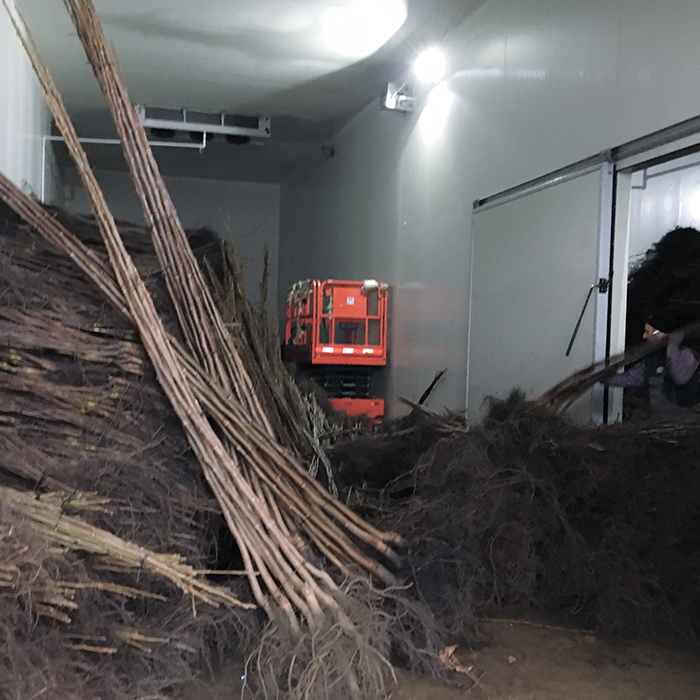
We are the largest producer of walnut trees in Europe. Our production fields are located in Turkey but we export our trees to all countries.
We send the young walnut trees bare rooted and dormant (in winter sleep). Our shipping season runs through the winter months, from November to April. We have phytosanitary certificates for all of our tree varieties, issued by the Turkish Ministry of Agriculture.
How to store your trees before planting: Choose a location that doesn't take much wind, it can be inside or outdoors. It is important that you store them somewhere preferably between 0 and 8 degrees celcius so that trees don't wake up from their winter sleep. Bury the roots of the trees in sand or soil and keep them like that until you plant them.
FREQUENTLY ASKED QUESTIONS
WALNUT TREE PRICES
Fill out a quick form and we can send you a price list in 24 hours.