HOWARD WALNUT TREE
ABOUT HOWARD VARIETY
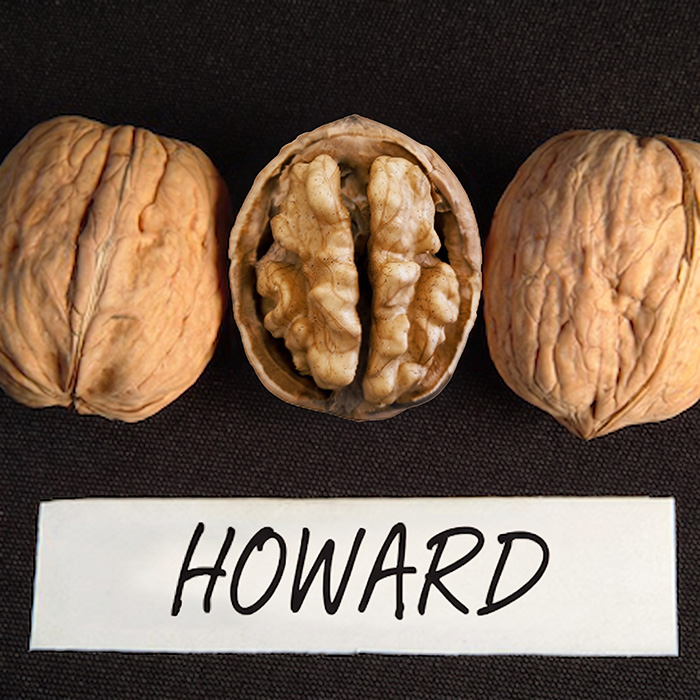
Howard (Juglans regia 'Howard') is a large-nut, high performance walnut variety developed by the University of California. It is the sister variety of Chandler, coming from the same cross, and it is one of the most widely planted commercial varieties in California.
Growers choose Howard for its large, well sealed nuts, its strong lateral bearing and its earlier harvest date, which lets you get your crop to the market before the main Chandler harvest begins.
HOWARD AT A GLANCE
- 14.3 g
- average nut weight, heavier than Chandler
- 7.2 g
- kernel weight
- 51%
- kernel percentage
- 80%
- of lateral buds carry female flowers
HOWARD WALNUT TREE SPECIFICATIONS
The figures below come from the University of California cultivar evaluation and from a seven year trial at Uludag University in Bursa, Turkey. Where the two differ, both are given: the difference reflects the site, the age of the trees and the measuring method rather than an inconsistency in the variety. Actual results on your own land depend on your soil, your water, your climate and your management.
- Variety name
- Howard
- Origin
- University of California, USA
- Parentage
- Sister variety of Chandler, from the same cross
- Bearing habit
- Lateral bearing, around 80% of lateral buds fruitful
- Tree shape
- Semi upright with a rounded canopy, slightly taller than wide
- Vigour
- Moderate, somewhat smaller than Chandler
- Leafing
- 2 April (UC), 16 April (Bursa) — slightly earlier than Chandler
- Harvest
- 28 September (UC) — about 10 days before Chandler
- Nut weight
- 14.3 g (UC), 13.17 g (Bursa)
- Nut dimensions
- Approximately 40 x 38 x 36 mm
- Kernel weight
- 7.2 g (UC), 6.14 g (Bursa)
- Kernel percentage
- 51% (UC), 51-56% in the original evaluation
- Kernel colour
- Light
- Shell
- Light coloured, medium thickness, strong and very well sealed
- First bearing
- Grafted trees produced their first female flowers at 2 years old
- Regularity of bearing
- Early and regular, with no yearly fluctuation recorded in Bursa
- Pollenizer
- Franquette, 5% of the trees
- Rootstock
- Juglans regia (English walnut)
- Planting distance
- 7 x 5 m recommended (280 trees per hectare), 6 x 5 m for smaller orchards
- Best for
- Large in-shell walnuts, an early harvest, spreading the harvest workload
KEY FEATURES OF HOWARD WALNUT TREE
- Yield
- Howard is a lateral bearing variety. In its original University of California evaluation, around 80 percent of its lateral (side) buds carried female flowers, and it produced heavily on almost all of its terminal buds as well. This is what makes lateral bearing varieties so productive: the tree fruits along the whole length of the branch instead of only at the tips. Howard is also an early bearer. Young grafted Howard trees produced their first female flowers at 2 years old. In a long term University of California trial on marginal soils, Howard and Chandler accumulated almost the same total yield over twelve crop years in the same trial, which shows what Howard is capable of in a well managed, well irrigated orchard.
- Nut and shell quality
- Howard produces a large nut. In the University of California cultivar table Howard averages 14.3 grams, compared with 13.2 grams for Chandler, and in a seven year Turkish university trial in Bursa Howard averaged 13.17 grams against 12.36 grams for Chandler. The shell is light coloured, medium thickness and very well sealed, which protects the kernel inside during the season and during handling. Kernel weight is approximately 7.2 grams in the University of California table, higher than Chandler's 6.5 grams. Kernel colour is light. The combination of a big nut and a strong, well sealed shell is why Howard is very often sold as an in-shell walnut, where nut size is one of the main things the buyer pays for.
- Tree size
- Howard is a moderately vigorous, semi upright tree. It is slightly taller than it is wide, with a rounded canopy. In the original variety description it is a medium sized tree, somewhat smaller than Chandler, and University of California notes that in some locations it is not as vigorous as Chandler. In practice this means Howard is a manageable tree that suits modern hedgerow orchards, and like all walnut trees it is kept to a working height and width by pruning.
- Leafing time and harvest date
- Howard leafs out slightly earlier than Chandler. University of California records leafing on 2 April for Howard and 4 April for Chandler, and in the Bursa trial Howard leafed on 16 April against 17 April for Chandler. The more important difference is at the other end of the season: Howard is harvested earlier. University of California gives 28 September for Howard and 8 October for Chandler. An earlier harvest means you reach the market sooner, you finish your harvest before the late autumn weather arrives, and if you plant Howard alongside Chandler you spread your harvest labour and your machinery over a longer window instead of trying to do everything at once. Because Howard starts its season slightly earlier than Chandler, it is best suited to sites where late spring frost is manageable.
- Pollination
- Howard is protandrous, which means it releases its pollen before its own female flowers become receptive. For this reason we strongly recommend planting a pollenizer variety with Howard. Franquette is the recommended pollenizer. In your orchard, 95 percent of the trees should be Howard and 5 percent should be Franquette.
- Rootstock
- At Waltree we bud Howard onto Juglans regia rootstock, known as English walnut. This is the rootstock we use for all of our varieties and it is the most commonly preferred rootstock for commercial orchards.
- Regularity of bearing
- Howard was described as an early and regular bearer in its original evaluation, and the Bursa researchers listed Howard among the varieties that did not show yearly yield fluctuation across their seven crop years. A variety that crops steadily every year is easier to plan around than one that swings between a heavy year and a light year.
- Lifespan
- Howard walnut trees live as long as any other English walnut tree. Walnut trees can live 100 years or longer.
- When to plant
- Howard can be planted from November until April of the following year, depending on your country. Please ask us if you are not sure.
HOWARD WALNUT TREE YIELD
Howard starts producing walnuts very early. Your trees will be 2 years old when you receive them and they can begin giving fruit in their first year after planting. As with all of our varieties, we recommend you remove the fruits for the first 3 years. Cut the walnuts off the tree when they emerge and do not let them develop. This lets the tree put its energy into a stronger trunk and a bigger root system instead of into a small crop, and it pays you back with much higher production later. From the fourth year onwards you can start collecting and selling the walnuts from your orchard.
Yield then increases gradually every year. After roughly the tenth year the tree reaches its mature production level and stays there. How much you actually get depends strongly on how the orchard is run. Soil depth, irrigation, spacing and harvest management all move the number. The table gives indicative figures for a well managed, irrigated orchard. If you tell us about your land we will give you a realistic production expectation for your specific conditions.
Howard Walnut Tree Yield Table
Indicative yield in tons of dry, in-shell walnuts per hectare, at the 7 x 5 meters spacing we recommend for Howard, which is 280 trees per hectare. Actual results depend on your soil, water, climate and management.
| Years after planting | Tons per hectare (in-shell) |
|---|---|
| 1 | 0 |
| 2 | 0 |
| 3 | 0.39 |
| 4 | 1.08 |
| 5 | 1.92 |
| 6 | 2.64 |
| 7 | 4.02 |
| 8 | 4.8 |
| 9 | 5.7 |
| 10+ | 6.12 |
TREE SPACING AND ORCHARD PLANNING
We recommend 7 x 5 meters spacing for Howard walnut trees, the same hedgerow scheme we recommend for Chandler. This gives you 280 trees per hectare. The hedgerow design places the trees close together within the row and leaves a wider alley between the rows, so that your harvesting machine, sprayer and tractor can move freely while the trees still fill their space quickly. Hedgerow planting gives you earlier returns and higher yield per hectare in a shorter time.
| Planting scheme | Trees per hectare | Orchard type |
|---|---|---|
| 7 x 5 meters | 280 trees | Recommended hedgerow |
| 6 x 5 meters | approximately 333 trees | Smaller orchards, tractor only |
Howard's moderate vigour and semi upright habit make it a good fit for this kind of intensive system. It has been grown commercially in California at spacings from 12 x 25 feet down to 12 x 18 feet, and at 7 x 7 meters in the Bursa trial, so it adapts to a range of orchard designs.
How many trees fit on your land?
Please enter the area of your land below to calculate number of trees you can plant at 7 x 5 meters spacing.
Remember to plant Howard together with its pollenizer, Franquette. We recommend 95 percent of your trees as Howard and 5 percent as Franquette. You can plant the pollenizer trees in the same row so that they are easy to identify once the trees grow. Pollenizers should be planted upwind of the main variety so that the wind carries the pollen across the orchard. In large or isolated blocks, and in the first years while the young trees are still producing few catkins, it is worth being generous with your pollenizer placement rather than minimal.
One more point in Howard's favour when you are planning: because Howard is harvested about a week to ten days before Chandler, planting both varieties lets one harvesting crew and one set of machinery cover a much larger orchard. Many of our clients plant Howard as their early block and Chandler as their main block for exactly this reason.
HOWARD WALNUT AND KERNEL CHARACTERISTICS
Howard produces a large nut with a short elliptical shape and slightly flattened ends. A well grown nut measures approximately 40 mm long, 38 mm across the cheek and 36 mm across the suture.
- Shell
- The shell is light coloured with a medium texture and medium thickness, and it is very well filled and very well sealed. In the Bursa trial Howard's shell measured 2.23 mm and was classed as strong, compared with 1.98 mm for Chandler at the same site. A strong, tightly sealed shell is a real commercial asset: it protects the kernel from birds, insects and weather, and it keeps the nut in good condition through drying, transport and storage.
- Kernel weight
- The kernel is light coloured, plump and well filled. Kernel weight is approximately 7.2 grams in the University of California table and 6.14 grams in the Bursa trial, in both cases above Chandler measured by the same method.
- Kernel percentage
- Kernel percentage, meaning the share of the whole nut that is edible kernel, was recorded at 51 to 56 percent in the original University of California evaluation, 51 percent in the University of California cultivar table, and 43.66 percent in Bursa where Chandler measured 43.92 percent. The range reflects different sites, ages and measuring methods rather than an inconsistency in the variety, and in every one of those comparisons Howard sits at or above Chandler.
- Kernel colour
- Kernel colour is light. To get the best colour out of Howard, harvest at proper physiological maturity and do not over-irrigate towards harvest. University of California research found that late harvest combined with excess irrigation was what pushed Howard kernels towards amber.
- Getting the colour right
- Growers who harvest on time, dry promptly and keep the nuts cool get the light kernel that Howard is capable of. This is normal good orchard practice and it is well within the reach of any professionally managed orchard.
HOWARD COMPARED WITH CHANDLER
Howard and Chandler come from the same University of California cross, so they have a great deal in common: both are lateral bearing, both are moderately vigorous and semi upright, both are protandrous and both use Franquette as a pollenizer. The differences that matter to a grower are these:
| Howard | Chandler | |
|---|---|---|
| Nut weight | 14.3 g (UC) / 13.17 g (Bursa) | 13.2 g (UC) / 12.36 g (Bursa) |
| Kernel weight | 7.2 g (UC) / 6.14 g (Bursa) | 6.5 g (UC) / 5.73 g (Bursa) |
| Kernel percentage | 51% (UC) / 43.66% (Bursa) | 49% (UC) / 43.92% (Bursa) |
| Shell | Medium thickness, strong, very well sealed | Thinner, smooth |
| Leafing | 2 April (UC) / 16 April (Bursa) | 4 April (UC) / 17 April (Bursa) |
| Harvest | 28 September (UC) | 8 October (UC) |
| Tree vigour | Moderate, semi upright | Moderately vigorous, semi upright |
| Pollenizer | Franquette, 5% | Franquette, 5% |
| Typical market | Large in-shell walnut | Light kernel, halves |
In short: Howard gives you a bigger nut, a heavier kernel and an earlier harvest, in a slightly more compact tree. Chandler gives you a thinner shell and an extra-light kernel that is very easy to crack out into halves. Which one is right for you depends mainly on what you intend to sell. If your buyer pays for nut size and in-shell presentation, Howard is a very strong choice. If your buyer pays for kernel colour and halves, Chandler remains the reference. Many commercial orchards plant both, which is why Howard sits on around 29,000 bearing acres in California alongside Chandler.
Read the full details on these pages: CHANDLER WALNUT LARA WALNUT Fernor Walnut Tree Walnut Varieties
WHERE HOWARD PERFORMS BEST
Howard rewards a well organised orchard. It performs best where:
- The site has adequate winter chill for your production region.
- Late spring frost can be managed, since Howard leafs slightly earlier than Chandler.
- Irrigation is precise and controlled, ideally by drip, so that water can be managed carefully as harvest approaches.
- Pollenizer trees are planned into the layout from the start rather than added later.
- Harvest is carried out at proper maturity, and the nuts are dried and cooled promptly afterwards.
- The market values a large, well sealed in-shell walnut.
If you can offer these conditions, Howard is a highly rewarding commercial variety. If you are not sure whether your land suits Howard, contact us. We look at your altitude, your year round temperatures, your rainfall and your soil analysis and tell you honestly which of our varieties will do best for you.
BUYING AND STORING YOUR HOWARD WALNUT TREES
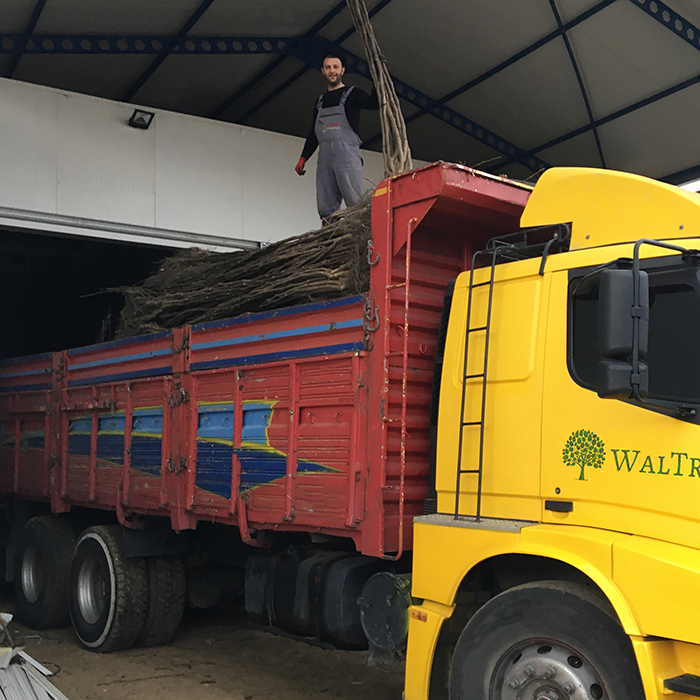
We have Howard walnut trees for sale every year from November until the end of March. We are the largest producer of walnut trees in Europe. Our production fields are located in Turkey but we export our trees to all countries. Do you need the trees delivered to your country? We can arrange a transportation company to deliver the trees to your location. Please ask us the transportation cost to your country.
We wash the roots of the trees before loading them onto the truck and clear them of any soil. We send the young walnut trees bare rooted and dormant, in their winter sleep. We have phytosanitary certificates for all of our tree varieties. Our nursery prepares every document needed to export the trees. All you have to do is be ready to receive the trees at your location.
You can plant the trees within a week of delivery or store them until you are ready to plant. Not ready to plant your trees? Choose a location that does not take much wind, indoors or outdoors. It is important to store them somewhere preferably between 0 and 8 degrees Celsius so that the trees do not wake up from their winter sleep. Bury the roots of the trees in sand or soil and keep them like that until you plant them.
FREQUENTLY ASKED QUESTIONS
WALNUT TREE PRICES
Fill out a quick form and we can send you a price list in 24 hours.