LARA WALNUT TREE
ABOUT LARA VARIETY
Lara (Juglans regia 'Lara') is a French walnut variety that produces some of the largest and most attractive in-shell walnuts available today. It was selected in France and it is registered in the French system as Lara® Pierral (INFEL 480). It is a lateral bearing variety, which means it starts producing early and gives high yields in modern high density orchards.
Lara is a very good choice for growers who sell their walnuts in shell, or who sell fresh walnuts, because buyers pay more for big, clean, thin shelled nuts. Its large calibre of 32-38 mm puts it at the top end of the market for in-shell walnuts.
- Nut size: Lara produces a very large nut, 32-38 mm and 10-13 grams. This is larger than Chandler, Fernor and Franquette, and large calibre in-shell walnuts sell for higher prices in almost every market.
- Bearing habit: Lara bears its fruit on lateral shoots, not only on the tips of the branches. This is why lateral bearing varieties like Lara and Chandler produce much earlier and much more than traditional varieties.
- Yield: Lara is a productive variety. The French technical record gives approximately 4.5 tons of walnuts per hectare at 8 x 4 meters planting, and a well managed orchard reaches around 5.5 tons per hectare in full production. See the yield table further down this page for the year by year figures.
- Nut and shell quality: Lara's shell is thin and it cracks easily, and its kernel is fairly light in colour. The kernel constitutes 45-51% of the walnut and the cracking yield is approximately 45-50%.
- Leafing time: Lara leafs out about 6-7 days later than Chandler. Later leafing gives the tree a useful safety margin against spring frost compared to earlier varieties.
- Harvest: Lara is an early maturing variety, harvested from mid September to mid October depending on the region. That is around 5-9 days earlier than Fernor and Franquette.
- Pollination: We recommend planting 5-10% pollenizer trees with Lara. Franquette, Fernette, Ronde de Montignac and Meylanne are all suitable pollenizers.
- Rootstock: At Waltree we bud Lara onto Juglans regia rootstock (known as English walnut). It is a commonly preferred rootstock because of its tolerance to blackline disease.
- When to plant: Lara can be planted from November until mid-April of next year. Best planting time depends on your country and on your land's location. Please ask us if you are not sure.
LARA AT A GLANCE
- 32-38
- mm nut size, one of the largest in-shell walnuts
- 10-13
- grams per nut
- 45-51%
- kernel percentage
- 4.5
- tons per hectare at 8 x 4 m
LARA WALNUT TREE SPECIFICATIONS
The figures below are taken from the French technical record for the variety. Actual results on your own land depend on your soil, your water, your climate and your management.
- Variety name
- Lara® Pierral
- Origin
- France
- Bearing habit
- Lateral bearing
- Tree shape
- Semi upright to semi spreading
- Vigour
- Medium
- Leafing
- Late, around 6-7 days later than Chandler
- Budbreak
- Approximately 8 April in France
- Harvest
- Early, mid September to mid October depending on region
- Nut size
- 32-38 mm
- Nut weight
- 10-13 g
- Kernel weight
- 4.6-6.3 g
- Kernel percentage
- 45-51%
- Kernel colour
- Fairly light
- Shell
- Thin, easy to crack
- Cracking yield
- 45-50%
- Pollenizers
- 5-10% Franquette, Fernette, Ronde de Montignac or Meylanne
- Planting distance
- 8 x 4 m high density, 7 x 5 m for large orchards, 6 x 5 m for smaller orchards
- Yield guidance
- Approximately 4.5 t/ha at 8 x 4 m
- Best for
- Large in-shell walnuts, fresh walnut sales, export calibre fruit
WHY GROWERS CHOOSE LARA
Very large nuts
Lara's nut size is 32-38 mm and its nut weight is 10-13 grams. This is larger than Chandler, Fernor and Franquette. Large calibre in-shell walnuts sell for higher prices in almost every market.
Lateral bearing and early production
Lara bears its fruit on lateral shoots, not only on the tips of the branches. This is the reason lateral bearing varieties like Lara and Chandler produce much earlier and much more than traditional varieties.
Thin shell and easy cracking
Lara's shell is thin and it cracks easily. This is a big advantage both for the table market and for growers who crack their own walnuts.
Light kernel and mild taste
Lara's kernel is fairly light in colour and research in Italy found that Lara has a lower polyphenol content than local traditional varieties, which is associated with a mild, non-bitter taste.
Early harvest
Lara matures earlier than Fernor and Franquette, usually around 5-9 days earlier. An earlier harvest means you finish your season before the autumn rains and you can reach the market earlier.
Later leafing than Chandler
Lara leafs out about 6-7 days later than Chandler. This gives it a useful safety margin in the spring compared to earlier varieties.
Suitable for modern orchards
Lara is trained to a central vertical axis and it works very well in intensive orchard systems, including 8 x 4 meters high density planting.
LARA WALNUT TREE YIELD
Lara is a productive variety, although it does not carry the tonnage of Chandler on the same land. The French technical record gives approximately 4.5 tons per hectare with 8 x 4 meters planting.
In a six year research trial in Southern Bulgaria, Lara trees grown under irrigation produced an average of 17.15 kilograms per tree, with a cumulative yield of 13,717 kilograms per hectare over the reported crop years. This trial was planted at a wide 8 x 8 meters spacing. In a modern high density orchard with good management the yield per hectare is considerably higher because you have more trees on the same land.
Like all walnut varieties, Lara starts producing small amounts of walnuts in the first years after planting. We advise you not to collect the walnuts in the first 3 years. In these years it is better for the tree to use its energy for building strong roots and a strong trunk. This gives you much higher yields in the long term.
Lara Walnut Tree Yield Table
The table below shows indicative yield in tons of dry, in-shell walnuts per hectare, in an irrigated orchard with good soil and proper pruning. The figures are calculated on the same 7 x 5 meters spacing as our Chandler yield table, which is 280 trees per hectare, so that you can compare the two varieties directly. At the 8 x 4 meters spacing we recommend for Lara you have more trees on the same land, so a well managed orchard reaches these levels sooner. Actual results depend on your soil, water, climate and management.
| Years after planting | Tons per hectare (in-shell) |
|---|---|
| 1 | 0 |
| 2 | 0 |
| 3 | 0.36 |
| 4 | 0.99 |
| 5 | 1.76 |
| 6 | 2.42 |
| 7 | 3.69 |
| 8 | 4.4 |
| 9 | 5.23 |
| 10+ | 5.61 |
Yields increase gradually until around the tenth year and then the orchard reaches its full production level. Trees that are planted at a larger size start producing earlier because they already have stronger roots and a larger trunk.
LARA WALNUT AND KERNEL CHARACTERISTICS
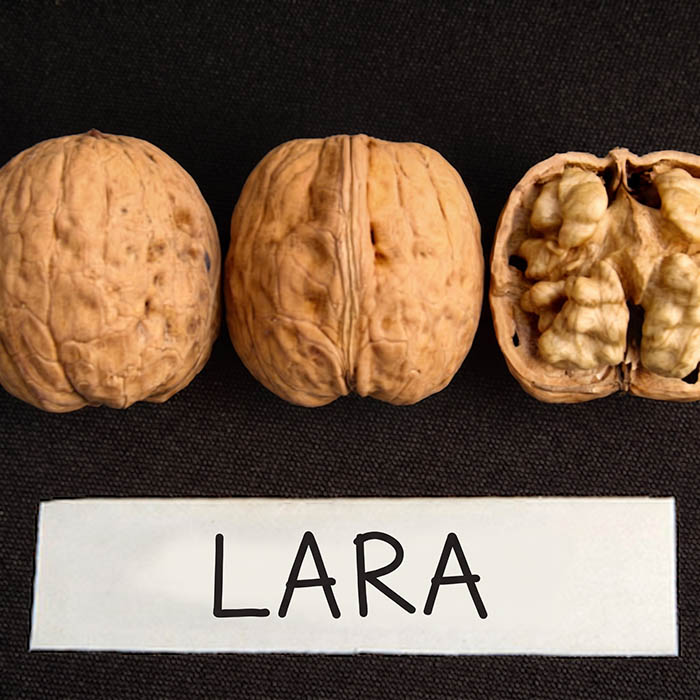
Lara produces a globular, well shaped nut with a marked suture and a thin shell.
- Nut size
- Lara's nut size is 32-38 mm. In a Bulgarian research trial the measured nut dimensions were 37.14 x 35.60 x 35.62 mm.
- Nut weight
- Average nut weight is 10-13 grams. The same Bulgarian trial measured 12.68 grams.
- Shell
- The shell is thin, measured at 1.4 mm in the Bulgarian trial. A thin shell means more kernel and a nut that is easy to open.
- Kernel weight
- Lara's kernel weight is 4.6-6.3 grams.
- Kernel percentage
- The kernel constitutes 45-51% of the walnut. This can vary depending on your soil, irrigation and crop load.
- Kernel colour
- Lara's kernel colour is fairly light. Colour is one of the most important factors in determining the selling price of walnuts, so it is important to dry and store the walnuts properly to protect the colour.
- Cracking
- Lara is easy to crack and the cracking yield is approximately 45-50%.
- Taste
- Research in Italy measured a lower polyphenol and ellagitannin content in Lara compared to local traditional varieties, which is associated with low bitterness and a mild flavour.
LARA WALNUT SIZE
Lara is one of the largest in-shell walnuts among the commercial French varieties. Below is a comparison of nut calibre and nut weight based on the French technical records.
| Variety | Nut size | Nut weight |
|---|---|---|
| Lara | 32-38 mm | 10-13 g |
| Chandler | 32-36 mm | 9-12 g |
| Fernor | 28-32 mm | 9-12 g |
| Franquette | 28-32 mm | 9.5-12 g |
If your market pays a premium for large calibre in-shell walnuts, or if you sell fresh walnuts, Lara is one of the strongest options you can plant. If your market pays mainly on kernel percentage and kernel colour, please read the comparison section further down this page before you decide.
TREE GROWTH AND SHAPE
Lara grows in a semi upright to semi spreading shape with medium vigour. Like all walnut trees, Lara is a full size tree, but in a commercial orchard it is pruned and kept much smaller.
Lara should be trained to a single vertical central axis. Maintenance pruning is essential for this variety. Light that reaches the inside of the canopy is what creates flower buds and large nuts, so if the tree becomes too dense the nut size and the yield both drop. Growers who prune Lara properly every year get the best results from it.
In some conditions Lara grows more vigorously than expected. In the Bulgarian trial the trees were classified as vigorous with a crown volume of 130.4 m³ at 8 x 8 meters spacing. For this reason you should plan your spacing and your pruning strategy according to the vigour you actually see on your own land.
POLLINATION
Lara is a monoecious tree, meaning it carries both male catkins and female flowers on the same tree. However, the male and female flowering periods do not always overlap fully, and the overlap changes from region to region and from season to season.
For this reason we recommend planting pollenizers with Lara. The French technical recommendation is 5-10% pollenizer trees, planted on the side that receives the prevailing wind, so that the pollen is carried across the orchard.
Recommended pollenizers for Lara
| Pollenizer | Role |
|---|---|
| Franquette | Main pollenizer, covers full female bloom |
| Fernette | Main pollenizer, covers full female bloom |
| Ronde de Montignac | Covers the end of Lara's flowering period |
| Meylanne | Used as a good pollenizer in south east France |
In a practical orchard plan, 90-95% of the trees are Lara and 5-10% are pollenizers. Using two different pollenizers instead of one gives you a longer pollination window and protects your crop in years when the spring is unusual.
FLOWERING AND HARVEST TIME
Lara's approximate flowering calendar in France is:
| Stage | Approximate date |
|---|---|
| Budbreak | 8 April |
| Peak male bloom | 24 April |
| Peak female bloom | 7 May |
These dates shift according to your country, altitude and season. What stays consistent is the order: Lara leafs out later than Chandler, and earlier than Fernor and Franquette.
Lara is an early maturing variety. In France the harvest window runs from a few days before 15 September up to 15 October depending on the region. In practice this means Lara is harvested before Fernor and Franquette, usually about 5-9 days earlier.
SOIL, LAND AND CLIMATE
Lara performs best on deep, well drained and fertile soil with a secure irrigation system. Drip irrigation is essential for a commercial Lara orchard. A few points to keep in mind when you choose the location for your Lara orchard:
- Choose a well drained site. Lara does not like low lying, humid ground where cold air collects in the spring.
- Avoid strongly alkaline soils. Lara can show iron chlorosis on soils that tend towards alkaline.
- Make sure you can irrigate. Lara rewards good water and good nutrition with large nuts and high yields.
- Plan for annual pruning. Lara is a variety that responds strongly to good canopy management.
If you are not sure whether your land is suitable, please contact us. We can review your altitude, your year round temperatures, your humidity, your soil type and your soil analysis report, and tell you whether Lara or another variety is the better match for your land.
LARA WALNUT TREE PLANTING DISTANCE
Lara is suitable for high density planting. The French documented planting systems for Lara are:
| Planting scheme | Trees per hectare | Orchard type |
|---|---|---|
| 8 x 4 meters | approximately 313 trees | Intensive, vertical axis hedgerow |
| 7 x 8 meters | approximately 179 trees | Semi intensive |
| 10 x 10 meters | approximately 100 trees | Traditional, wide spacing |
Our suggestion for large commercial orchards is a high density scheme such as 8 x 4 meters or 7 x 5 meters. These distances allow big machinery such as a harvesting machine to move between the rows while still giving you a high number of trees per hectare. For smaller orchards where you will only use a tractor, a 6 x 5 meters scheme also works well.
How many trees fit on your land?
Please enter the area of your land below to calculate number of trees you can plant at 8 x 4 meters spacing.
LARA COMPARED TO OTHER VARIETIES
Every variety has its own strengths and the right choice depends on your land and on the market you sell to. The table below shows the main figures side by side so that you can compare them directly.
| Lara | Chandler | Fernor | Franquette | |
|---|---|---|---|---|
| Origin | France | California, USA | France | France |
| Bearing habit | Lateral | Lateral | Lateral | Terminal |
| Nut size | 32-38 mm | 32-36 mm | 28-32 mm | 28-32 mm |
| Nut weight | 10-13 g | 9-12 g | 9-12 g | 9.5-12 g |
| Kernel percentage | 45-51% | 47-52% | 45% | 40-45% |
| Kernel colour | Fairly light | Very light | Light | Light |
| Leafing | Late | Late | Very late | Very late |
| Harvest | Early | Early to mid October | First half of October | Late September to mid October |
| Yield guidance | 4.5 t/ha (8 x 4 m) | 4.5 t/ha (8 x 4 m) | 4 t/ha (8 x 4 m) | 2 t/ha (11 x 11 m) |
| Pollenizers | 5-10% Franquette, Fernette, Ronde de Montignac or Meylanne | 5-10% Franquette or Fernette | 5-10% Fernette then Ronde de Montignac | 5-10% Meylannaise, Ronde de Montignac |
Lara and Chandler
Lara and Chandler are both lateral bearing varieties and the French technical records give both of them the same yield guidance of approximately 4.5 tons per hectare at 8 x 4 meters. They are close in many ways and the differences between them are mostly about nut characteristics and timing.
Where Lara is different: Lara's nut calibre and nut weight are at the top of the range at 32-38 mm and 10-13 grams. Lara also leafs out around 6-7 days later than Chandler.
Where Chandler is different: Chandler's listed kernel percentage is higher at 47-52%, and its kernel colour is very light with an internal whiteness rate of 90% or better. Chandler is a very high lateral bearer, with around 90 percent of its lateral branches productive, and it is self pollinating, although a Franquette pollenizer still gives better results. Chandler is also the most widely planted modern variety worldwide, which means the market, the packing houses and the buyers all know it well.
In short, Chandler is usually the stronger choice where kernel percentage and very light kernel colour drive the price, and Lara is usually the stronger choice where in-shell calibre and fresh walnut sales drive the price. Both are proven commercial varieties and we produce and sell both.
Lara and Fernor
Lara has a larger nut, a thinner shell and an earlier harvest than Fernor. Fernor leafs and blooms considerably later than Lara and is the more conservative choice on sites where spring frost or hard winter cold is the main concern. Fernor's measured kernel percentage has also been higher than Lara's in side by side trials.
Lara and Franquette
Franquette is a traditional terminal bearing variety planted at wide spacing. It is very late leafing, which is its main advantage, but it produces a smaller nut, a lower kernel percentage and much lower yields per hectare than lateral bearing varieties such as Lara. Franquette is most often planted today as a pollenizer or in traditional wide spaced orchards.
Read the full details on these pages: CHANDLER WALNUT Fernor Walnut Tree Walnut Varieties
HARVEST, DRYING AND STORAGE
Because Lara's kernel is fairly light in colour, correct drying and storage are important to protect the colour and the selling price. The recommended storage conditions are:
| Product | Temperature | Humidity |
|---|---|---|
| Fresh walnuts | below 4 °C | 90% relative humidity |
| Dried in-shell walnuts | below 10 °C | 70% relative humidity |
Walnuts that are stored in warm or badly controlled conditions lose their kernel colour and lose value. A well organised drying and storage facility pays for itself in a Lara orchard.
OUR LARA WALNUT SAPLINGS
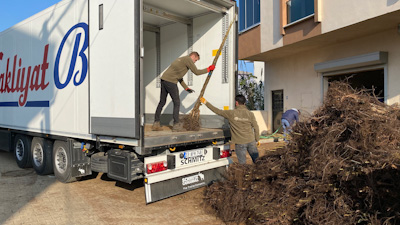
We are the largest producer of walnut trees in Europe. Our production fields are located in Turkey but we export our trees to all countries.
We send the young walnut trees bare rooted and dormant (in winter sleep). Our shipping season runs through the winter months, from November to April. We have phytosanitary certificates for all of our tree varieties, issued by the Turkish Ministry of Agriculture.
How to store your trees before planting: Choose a location that doesn't take much wind, it can be inside or outdoors. It is important that you store them somewhere preferably between 0 and 8 degrees celcius so that trees don't wake up from their winter sleep. Bury the roots of the trees in sand or soil and keep them like that until you plant them.
FREQUENTLY ASKED QUESTIONS
WALNUT TREE PRICES
Fill out a quick form and we can send you a price list in 24 hours.