ROBERT LIVERMORE WALNUT TREE
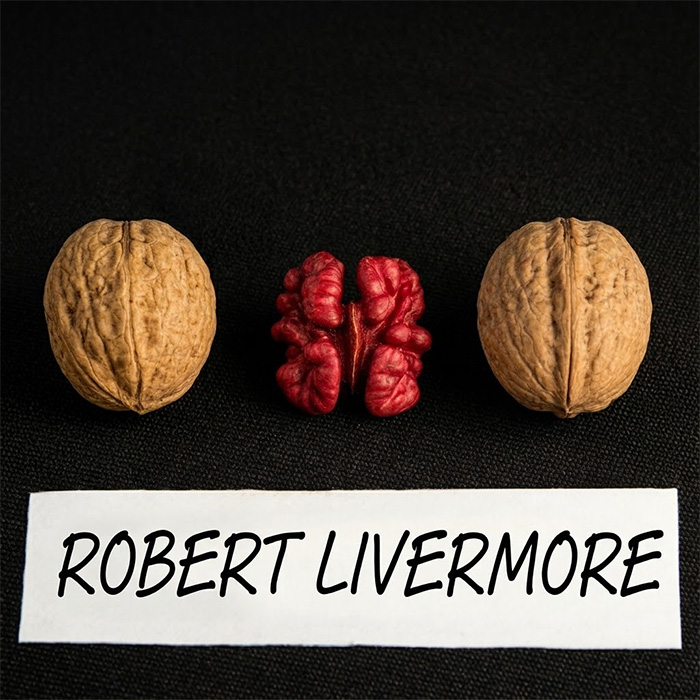
ABOUT ROBERT LIVERMORE VARIETY
Robert Livermore (Juglans regia 'Robert Livermore') is the red walnut. It is a University of California variety and it is the one commercial walnut cultivar whose kernel skin is naturally red to purple instead of the usual light tan.
Everything else about the tree is familiar. It is a lateral bearing English walnut of moderate vigour, similar in size and habit to Chandler, it leafs out at the same time as Chandler, and it is harvested about ten days earlier. If you already know how to grow Chandler, you already know how to grow this tree.
The red colour is not a treatment and not a defect. It is inherited from the red seedcoated parent used in the cross, and when you crack a Robert Livermore walnut the kernel underneath is a normal, well filled, good quality walnut kernel wearing a red coat. That single trait changes what the variety is for: it is a variety you plant when you have a market that will pay for the way the kernel looks.
ROBERT LIVERMORE AT A GLANCE
- Red
- kernel skin, naturally red to purple, not treated or dyed
- 48-50%
- kernel percentage, alongside Chandler's published figures
- 9-10
- days earlier harvest than Chandler
- 1999
- released by the University of California
- Kernel colour: The pellicle, the thin skin around the kernel, is naturally red to purple, and the University of California cultivar table describes it as distinctive and uniform. The pigment comes from anthocyanin type compounds, the same family of natural pigments that colour red grapes and cherries. The kernel underneath the red skin is a normal cream coloured walnut kernel.
- Nut size: The original cultivar record gives average dimensions of 36.4 x 35.8 mm, which makes it an essentially round nut, and describes it as jumbo at 14.8 grams. The University of California table gives 12.9 grams and calls the nut moderately small. The two records disagree, so expect a nut broadly in the 13-15 gram range and confirm it on your own site.
- Bearing habit: Robert Livermore is lateral bearing, with around 90% of the lateral buds fruitful in the young trees described in the original cultivar record, and it is described as regular bearing rather than alternate bearing. The record also notes first bloom in the third year, at the fourth leaf.
- Yield level: Moderate in the University of California cultivar table, against strong for Chandler, and the original cultivar record reports yields tending below Chandler. This is a variety to plant for the value of each kilogram, not for kilograms per hectare. We would rather tell you that before you plant than after.
- Shell: Strong, thick, well sealed and well filled, with kernels that come out of the shell easily. A strong shell is an advantage in transport and in in-shell presentation. No published commercial cracking trial gives a percentage of halves for this variety, so we do not quote one.
- Leafing time: Around 3 April in the California reference table, effectively the same time as Chandler. Robert Livermore is not a late leafing variety, whatever you may have read. If your main concern is a difficult spring, ask us about Fernor or Franquette instead.
- Harvest time: Around 29 September in the California reference table, roughly 9-10 days before Chandler on 8 October. In one direct year-by-year comparison the trees were ready on 2 October against Chandler's 12 October. Your own dates shift with your country, altitude and season.
- Pollination: The University of California cultivar table lists Franquette, Cisco and Fernette, the same three pollenizers listed for Chandler. Franquette is our recommendation and the one we produce ourselves. Plan on around 2-3% pollenizer trees as a starting point, and more in an isolated block.
- Rootstock: At Waltree we bud Robert Livermore onto Juglans regia rootstock (known as English walnut). It is a commonly preferred rootstock because of its tolerance to blackline disease.
- When to plant: Robert Livermore can be planted from November until mid-April of next year. Best planting time depends on your country and on your land's location. Please ask us if you are not sure.
ROBERT LIVERMORE WALNUT TREE SPECIFICATIONS
The figures below come from the University of California cultivar table and from the original cultivar record published when the variety was released. Where the two disagree we show both rather than picking the flattering one. Actual results on your own land depend on your soil, your water, your climate and your management.
- Variety name
- Robert Livermore, often sold as red walnut
- Origin
- University of California, USA (Howard x a red seedcoated French selection)
- Release year
- 1999
- Bearing habit
- Lateral bearing, approximately 90% of lateral buds fruitful in young trees
- Tree shape
- Semi upright, similar to Chandler
- Vigour
- Moderate, similar to Chandler
- Leafing
- Around 3 April in the California reference table, effectively the same time as Chandler
- Harvest
- Around 29 September in the California reference table, roughly 9-10 days before Chandler
- Nut size
- Approximately 36 x 36 mm, round, in the original cultivar record
- Nut weight
- 12.9 g in the University of California table, 14.8 g in the original cultivar record
- Kernel weight
- 6.4-7.1 g
- Kernel percentage
- 48-50%
- Kernel colour
- Red to purple, described as distinctive and uniform
- Shell
- Strong, thick, well sealed and well filled; kernel removes easily
- Bearing pattern
- Regular bearing
- Yield level
- Moderate
- Pollenizers
- Franquette (our recommendation), Cisco, Fernette
- Planting distance
- 7 x 5 m for large orchards, 6 x 5 m for smaller orchards
- Best for
- Specialty and premium markets where the kernel is visible, and growers who already have a buyer for red walnuts
WHY GROWERS CHOOSE ROBERT LIVERMORE
It is genuinely different
Almost every commercial walnut on the market competes on the same qualities: size, colour, fill, halves. Robert Livermore competes on something no conventional variety can copy. A red kernel is instantly recognisable on a shelf, in a gift pack, on a plate or in a photograph. If you are building a brand or a differentiated product rather than selling into an anonymous commodity pool, that is a real advantage.
The colour is in the plant, not in the process
The pigment sits in the pellicle, the thin skin around the kernel, and it is inherited. You are not dyeing, coating or treating anything, which matters for clean label, natural and premium positioning.
A normal commercial kernel underneath
The original cultivar record describes the kernel as typical of commercial walnut cultivars in texture and flavour, well filled, and easy to remove from the shell. You are selling a distinctive appearance on top of a standard quality kernel, not a compromise.
Good kernel percentage
Published figures put the kernel at 48-50% of the nut, with a kernel weight of 6.4-7.1 grams. That sits right alongside Chandler's published figures in the same reference table. You are not giving up kernel fill in exchange for the colour.
Strong lateral bearing
Around 90% of the lateral buds were fruitful in the young trees described in the original cultivar record, and the variety is described as regular bearing rather than alternate bearing. Lateral bearing is what brings a modern orchard into production early and keeps yields steady from year to year.
Early harvest
Robert Livermore is harvested around 29 September against Chandler's 8 October. Nine or ten days earlier is a real operational benefit: you finish before the autumn weather turns, and if you also grow Chandler you spread your huller, dryer and labour across a longer window instead of doing everything at once.
A familiar tree to manage
Moderate vigour, semi upright, lateral bearing, leafing at effectively the same time as Chandler. If you or your consultant already know how to grow Chandler, you already know how to grow this tree. The difference is in the market, not in the orchard work.
ROBERT LIVERMORE WALNUT TREE YIELD
We want to be straightforward with you about this, because it is the single most important thing to understand before you plant Robert Livermore.
The University of California cultivar table classifies Robert Livermore's yield as moderate, while Chandler is classified as strong. The original cultivar record likewise reports that yields tended to be lower than Chandler in the observations made at the time. There is no published mature, replicated trial that gives tonnes per hectare for this variety, so anyone quoting you a precise figure is estimating.
What this means in practice
Robert Livermore is not the variety to plant if your plan is to maximise kilograms per hectare. It is the variety to plant if your plan is to maximise the value of each kilogram. The economics work through price per kilogram in a specialty channel, not through volume. If you have that channel, the moderate yield is an acceptable trade. If you do not have that channel, plant Chandler or Tulare instead, and we will tell you so honestly.
Robert Livermore walnut tree yield table
Indicative yield per tree in an irrigated orchard with good soil and proper pruning, using the moderate yield classification as the basis. Actual results depend on your soil, water, climate and management.
| Years after planting | Walnut yield per tree |
|---|---|
| 1 | — |
| 2 | — |
| 3 | — |
| 4 | 2 kg |
| 5 | 5 kg |
| 6 | 8 kg |
| 7 | 12 kg |
| 8 | 16 kg |
| 9 | 20 kg |
| 10+ | 22 + kg |
Like all walnut varieties, Robert Livermore starts producing small amounts of walnuts in the first years after planting. We advise you not to collect the walnuts in the first 3 years. In these years it is better for the tree to use its energy for building strong roots and a strong trunk, which gives you much higher yields in the long term.
Yields increase gradually until around the tenth year and then the orchard reaches its full production level. Trees that are planted at a larger size start producing earlier because they already have stronger roots and a larger trunk.
Start with a pilot block. Because there is no published mature yield trial for this variety, we recommend that anyone planting a large area starts with a pilot block on their own land. Plant a few hundred trees, confirm your own yield, your own harvest date and your own kernel colour over two or three cropping years, and then scale up with real numbers instead of assumptions. We are happy to help you plan that block.
ROBERT LIVERMORE WALNUT AND KERNEL CHARACTERISTICS
Two published records describe this variety and they do not agree on every figure. We show both rather than choosing the flattering one, because you will plan a business around these numbers.
- Kernel colour
- This is the headline. The pellicle is naturally red to purple, and the University of California cultivar table describes it as distinctive and uniform. The pigment comes from anthocyanin type compounds, the same family of natural pigments that colour red grapes, cherries and red cabbage. The colour is present in the kernel skin only; the kernel underneath is a normal cream coloured walnut kernel.
- How consistent is the colour?
- No published multi site trial has measured exactly how the red intensity varies between orchards, seasons, harvest dates, drying methods and storage periods. What is well documented is that walnut pellicle colour in general responds to growing conditions and to the stage at which the crop is picked. So we describe the colour as distinctive and reportedly uniform, and we recommend that you confirm the exact shade you get on your own land, with your own drying, before you commit to a packaging design or a colour specification with a buyer.
- Nut weight
- The University of California cultivar table lists a net nut weight of 12.9 grams. The original cultivar record, based on a four year average of ten nut samples from young trees, gives 14.8 grams and describes the nut as jumbo. The two sets of measurements were made under different conditions. Expect a nut broadly in the 13-15 gram range and confirm it on your own site.
- Nut size and shape
- The original cultivar record gives average dimensions of 36.4 mm long by 35.8 mm wide, which makes it an essentially round nut. The University of California table describes the nut as moderately small and dark. As with the weight, these two descriptions do not agree, and the honest answer is that nut size for this variety varies more between records than it does for a variety like Chandler. A round nut looks full in the shell and photographs well, which supports in-shell gift and premium packaging as well as kernel sales.
- Kernel weight and percentage
- Kernel weight is 6.4 grams in the University of California table and 7.1 grams in the original cultivar record. Both figures sit at or above Chandler's 6.5 grams in the same University of California table. Kernel percentage is 50% in the University of California table and 48% in the original record, against 49% for Chandler in the same table. In other words, the kernel fraction is competitive with the standard commercial benchmark.
- Shell
- The shell is described as strong, thick, well sealed and well filled, with kernels that are easy to remove. A strong shell is an advantage in transport and in in-shell presentation. No published commercial cracking trial gives a percentage of halves for this variety, so we do not quote one.
- Flavour and texture
- The original cultivar record describes the flavour as typical of commercial walnut cultivars. We deliberately do not claim that Robert Livermore is sweeter, creamier, less bitter, lower in tannins or nutritionally superior to standard walnuts, because no reliable comparative study supports those claims. The variety sells on appearance, on a normal good quality kernel, and on the story of a natural red walnut. That is enough.
ROBERT LIVERMORE WALNUT SIZE
| Variety | Nut size | Nut weight | Kernel % |
|---|---|---|---|
| Robert Livermore | approx. 36 x 36 mm, round | 12.9-14.8 g | 48-50% |
| Tulare | approx. 36 x 40 mm | 13.3-14.1 g | approx. 53% |
| Lara | 32-38 mm | 10-13 g | 45-51% |
| Chandler | 32-36 mm | 9-13.2 g | 47-52% |
| Fernor | 28-32 mm | 9-12 g | 45% |
| Franquette | 28-32 mm | 9.5-12 g | 40-45% |
These figures come from different national reference systems, so they are best read as an indication of relative size rather than as exact laboratory comparisons. Chandler's nut weight, for example, is listed as 9-12 grams in the French record and 13.2 grams in the University of California table, and Robert Livermore's own two published records differ by nearly two grams.
Robert Livermore's round shape is worth mentioning on its own. A round nut looks full in the shell and photographs well, which supports in-shell gift and premium packaging as well as kernel sales.
TREE GROWTH AND SHAPE
Robert Livermore is a moderately vigorous tree, described in the University of California cultivar table as similar to Chandler in vigour, with a lateral bearing habit. In practice this means a manageable, familiar tree that suits standard modern orchard training.
In the original cultivar record, three year old trees at Davis, California were about 5.5 meters tall with a canopy diameter of about 3 meters. Those are young tree measurements from a research planting, not mature commercial orchard dimensions, but they confirm that the tree establishes at a normal pace. Like all walnut trees, Robert Livermore is a full size tree by nature, but in a commercial orchard it is pruned and kept much smaller.
Around 90% of the lateral buds were fruitful in the young trees described in that record. Lateral bearing means the tree carries female flowers on both the terminal and the side positions of the current season's growth, which is what allows a modern orchard to come into production early and to fill a hedgerow with fruiting wood rather than just leaves.
Training and pruning
We recommend a modified central leader, the same system used for Chandler:
- Remove branches below about 1.5-1.8 meters so that machinery can pass and so that the harvest is clean.
- Head the leader and select your permanent scaffolds in the first years.
- Keep some temporary branches in the early years. They contribute to early production and to trunk thickening, and you remove them later.
- Manage light. A lateral bearing variety only pays you back if sunlight reaches the fruiting wood inside the canopy. Plan an annual programme rather than occasional hard cuts.
There is no published pruning or training trial carried out specifically on Robert Livermore, so we apply the standard walnut principles that work for moderate vigour lateral bearing varieties. When you buy your trees from us we give you free consultation on pruning and training.
POLLINATION
Robert Livermore is monoecious, meaning it carries both male catkins and female flowers on the same tree. The University of California cultivar table lists three pollenizers for it, and they are the same three listed for Chandler: Franquette, Cisco and Fernette. The original cultivar paper also mentions Cisco and Tulare among satisfactory pollenizers.
Franquette is our recommendation. It is on that list, it sheds very late, and it is a variety we produce ourselves, so it ships with your order rather than having to be sourced separately. Cisco is the name that appears most often in the American records, but we do not grow it.
A full record of Robert Livermore's own catkin shedding curve has not been published, which means we cannot tell you exactly how much of its own female bloom its own pollen covers. For that reason we recommend that you plan pollination properly rather than assume the variety will look after itself.
How to plan it:
- Plan on pollenizer trees in the block rather than relying on the variety alone.
- General walnut guidance puts pollenizer trees at around 2-3% of the orchard. That is a starting point for your design, not a fixed rule. Isolated blocks with no other walnut orchards nearby need a higher proportion.
- Place pollenizers on the side that receives the prevailing wind, and run the remaining pollenizer rows across the wind direction. Walnut pollen travels a long way on the wind, and paternity studies in California have shown that a large share of the pollen reaching an orchard can come from outside it altogether.
- Confirm the actual bloom overlap on your own land in the first cropping years, because catkin shed and female bloom both shift with site, altitude and season.
- Think about what happens to the pollenizer crop. If you are selling an identity preserved red walnut lot, decide in advance whether the pollenizer nuts go into the same lot or get harvested and handled separately.
Pollenizer varieties
| Pollenizer | Role |
|---|---|
| Franquette | Our recommendation, and the one we produce ourselves so it can ship with your order. A traditional very late shedding pollenizer, widely available, and one of the three listed for Robert Livermore in the University of California cultivar table. |
| Cisco | The most commonly used dedicated walnut pollenizer in California and the name that appears most often in the American records for this variety. We do not produce it, so you would need to source it locally. |
| Fernette | French pollenizer selected to pair with late leafing varieties, and the third of the three listed in the University of California table. |
For reference, the female bloom dates recorded for the young trees in the original cultivar record averaged 21 April for first bloom, 26 April at peak and 1 May at the end, against 15, 22 and 29 April for the Chandler comparison in the same record. The two varieties bloom within roughly a week of each other.
FLOWERING AND HARVEST TIME
The approximate California reference calendar, with Chandler beside it for comparison:
| Stage | Robert Livermore | Chandler |
|---|---|---|
| Leafing | 3 April | 4 April |
| First female bloom | 21 April | 15 April |
| Peak female bloom | 26 April | 22 April |
| Last female bloom | 1 May | 29 April |
| Harvest | 29 September | 8 October |
These dates shift with your country, your altitude and your season. What stays consistent is the pattern: Robert Livermore leafs out at effectively the same time as Chandler and is harvested roughly 9-10 days earlier.
That earlier harvest is one of the practical reasons growers like this variety. It gets the crop off the tree before the autumn weather turns, it gets you into the market earlier for the autumn and pre-holiday season, which is exactly when a gift and specialty product sells best, and it spreads your harvest workload if you also grow a later variety.
It is not a late leafing variety
This is sometimes claimed and it is not correct. Robert Livermore comes into leaf at Chandler timing. If your main concern is a site with a difficult spring, this is not the variety that solves that problem, and we will point you towards a genuinely late leafing variety such as Fernor or Franquette instead.
SOIL, LAND AND CLIMATE
Robert Livermore wants what every commercial walnut wants: deep, well drained, fertile soil, and a secure irrigation system. Drip irrigation is essential for a commercial orchard. A few points to keep in mind when you choose the location:
- Choose a well drained site on open ground. Avoid low lying, humid pockets where cold air settles.
- Because the variety leafs and blooms at Chandler timing, evaluate your site exactly as you would for a Chandler block. If Chandler works well in your area, the climate fit is right. If your area is marginal for Chandler in spring, a later leafing variety is the more conservative choice, and we will tell you so.
- The earlier harvest can be a real advantage where the autumn turns wet early, because you are off the tree sooner.
- Plan your irrigation and fertigation before you plant.
- Plan for annual canopy management. Lateral bearing pays you back only if light reaches the fruiting wood.
If you are not sure whether your land is suitable, please contact us. We can review your altitude, your year round temperatures, your humidity, your soil type and your soil analysis report, and tell you whether Robert Livermore or another variety is the better match for your land.
PLANTING DISTANCE
Robert Livermore is a moderate vigour, Chandler-like tree, so standard modern walnut spacings apply. There is no density trial published specifically for this variety, so these are the general walnut frameworks, adapted to your own soil and conditions:
| Planting scheme | Trees per hectare | Orchard type |
|---|---|---|
| 6 x 5 meters | approximately 333 trees | Smaller orchards, tractor only |
| 7 x 5 meters | 280 trees | Intensive, suitable for large machinery |
| 6.7 x 4.6 meters (22 x 15 ft) | approximately 326 trees | Standard California hedgerow |
| 7.6 x 7.6 meters (25 x 25 ft) | approximately 172 trees | Traditional wide spaced orchard |
| 8.5 x 8.5 meters (28 x 28 ft) | approximately 137 trees | Traditional wide spaced orchard |
Our suggestion for large commercial orchards is 7 x 5 meters. This distance allows big machinery such as a harvesting machine to move between the rows while still giving you a high number of trees per hectare. For smaller orchards where you will only use a tractor, a 6 x 5 meters scheme also works well.
Wider traditional spacings around 137-185 trees per hectare are still used and give long term coverage with slower canopy fill. Intensive hedgerow spacings bring earlier combined yield but need cyclical mechanical hedging to hold the wall.
How many trees fit on your land?
Please enter the area of your land below to calculate number of trees you can plant at 7 x 5 meters spacing.
THE RED WALNUT MARKET
This is the part of the decision that matters most with this variety, so it deserves its own section. Robert Livermore was released for specialty markets, and that is where it belongs. The commercial case rests on appearance in channels where the buyer or the consumer actually sees the kernel.
Gift and holiday packs
Red kernels in a clear pack are a product in themselves. Autumn and winter gifting is the natural season, and the early harvest puts your crop in the market in good time for it.
Premium and specialty retail
Delicatessens, farm shops, organic and natural food retailers, and premium supermarket lines.
Chefs and restaurants
Red walnuts are used as a visible garnish on salads, cheese boards, desserts and plated dishes. Chefs pay for visual differentiation.
Bakery and confectionery
Decoration, toppings and inclusions where the colour survives on the surface of the product.
In-shell novelty and direct sales
A round nut with a red kernel inside is an easy sell at a farm gate, a market stall or a branded online shop.
Own brand and agritourism
If you sell under your own name, a variety nobody else in your region has is worth more to you than a variety everybody has.
There has been genuine commercial interest in red walnuts. Trade reporting from California in 2012 described specialty retail and restaurant use and a 130 acre planting, with red walnuts on the shelf at around two dollars per seven ounce pack above regular walnuts. A 2016 report quoted a buyer saying demand exceeded supply, with red walnuts at roughly 2.70-2.80 dollars per pound against around a dollar or less for conventional English walnuts in the same account.
We give you those numbers as evidence that a premium has existed in a real market, and we also want you to read them properly. They are dated stakeholder reports from a specific market and a specific period, not a current price series, not a contract, and not a promise that the premium holds at any volume.
Get your buyer before you plant the acreage
This is the same advice we would give a family member. Talk to a processor, a packer, a brand or a retailer, and agree in writing what volume they want, in what form, at what grade and at what price basis. A red walnut is worth a premium to a buyer who wants red walnuts, and is worth exactly the same as any other walnut to a buyer who does not.
Plant a pilot block first, prove your yield and your colour, and expand once the market is real for you rather than in principle. Growers who approach it that way tend to do very well with this variety, because there is almost no competition and the product sells itself on sight. Growers who plant a large block first and look for the market afterwards are taking a risk we would rather you avoided.
ROBERT LIVERMORE COMPARED TO OTHER VARIETIES
Every variety has its own strengths and the right choice depends on your land and on the market you sell to. The table below shows the main figures side by side.
| Robert Livermore | Chandler | Tulare | Lara | Fernor | |
|---|---|---|---|---|---|
| Origin | California, USA | California, USA | California, USA | France | France |
| Bearing habit | Lateral, approx. 90% of buds fruitful | Lateral, around 90% | Lateral, 75-78% | Lateral | Lateral |
| Tree habit | Semi upright, moderate vigour | Semi upright, moderately vigorous | Upright, vigorous | Semi upright to semi spreading | Semi upright |
| Nut size | approx. 36 x 36 mm | 32-36 mm | approx. 36 x 40 mm | 32-38 mm | 28-32 mm |
| Nut weight | 12.9-14.8 g | 9-13.2 g | 13.3-14.1 g | 10-13 g | 9-12 g |
| Kernel weight | 6.4-7.1 g | 6.5 g (UC) | 7.1-7.6 g | 4.6-6.3 g | — |
| Kernel percentage | 48-50% | 47-52% | 53% | 45-51% | 45% |
| Kernel colour | Red to purple | Extra light, easy halves | Light, well filled | Fairly light | Light |
| Yield level | Moderate in the UC table | Strong in the UC table | Highest yielding in the California hedgerow trial | — | — |
| Leafing | Early April, same as Chandler | Early April | Early April | Late | Very late |
| Harvest | Late September | Early to mid October | Late September | Early | First half of October |
| Pollenizers | Franquette, Cisco, Fernette | Self pollinating, better with a pollenizer | Good self overlap, often no pollenizer | 5-10% pollenizers | 5-10% pollenizers |
| Market role | Specialty, visible kernel | Mainstream benchmark | Large calibre, kernel weight | Large calibre, thin shell | Late leafing, cooler sites |
Robert Livermore and Chandler
These two are the honest comparison, because they are both University of California varieties, both lateral bearing, both moderate vigour, both leaf out at the same time, and both use the same pollenizers. The orchard work is nearly identical. What differs is the kernel and the market.
Where Robert Livermore is different: the red to purple pellicle, which no conventional variety offers, and which is the entire commercial reason to plant it. Harvest is roughly 9-10 days earlier, which helps where autumn weather arrives early or where you want to spread harvest across two varieties. Published kernel weight is at or slightly above Chandler's in the same reference table, and the nut is rounder and, in the original cultivar record, heavier.
Where Chandler is different: Chandler's kernel colour is extra light, which is the top standard colour grade and the one conventional buyers pay the most for, and Chandler kernels come out in halves more easily. Chandler is classified as strong yield against Robert Livermore's moderate, and the original Robert Livermore record itself reports yields tending below Chandler. Chandler is self pollinating. Chandler is by a very large margin the most widely planted modern walnut variety in the world, with more than 130,000 bearing acres in California alone, which means the packing houses, the buyers, the equipment and the whole supply chain already know it. And a Chandler crop can be sold to almost anyone, whereas a Robert Livermore crop needs a buyer who specifically wants red walnuts and a processor willing to handle it as a separate lot.
Which market each suits: Chandler suits growers who need volume, a standard extra light grade and the broadest possible buyer base, which is most growers. Robert Livermore suits growers who have, or can build, a specialty channel that pays for a red kernel, and who accept a moderate yield in exchange for a differentiated price. We produce and sell both, and we would rather you planted the right one. Many growers plant a Chandler block for their volume and a smaller Robert Livermore block for their premium line, which also works well because the two harvest dates are about ten days apart.
Robert Livermore and Tulare
Both are University of California varieties harvested in late September, about ten days before Chandler, so they combine in the same way with a later block. Tulare gives a bigger, heavier nut, a heavier kernel, a higher kernel percentage at around 53% and a strong yield classification, and it depends less on pollenizer trees. Tulare is the choice for volume and calibre. Robert Livermore is the choice for a visible red kernel in a specialty channel. Tulare is also the more vigorous, upright tree and needs more room in the row.
Robert Livermore and Lara
Lara gives a large, thin shelled nut that is easy to crack, and leafs out clearly later, around six or seven days after Chandler, which makes it the more conservative choice where spring is unreliable. Robert Livermore has a higher kernel percentage than Lara's 45-51%, a stronger and thicker shell that protects the kernel in transport, and of course the red pellicle. Lara is a mainstream market variety; Robert Livermore is a specialty market variety.
Robert Livermore and Fernor
These two answer different questions. Fernor leafs and blooms very late, which is its main advantage and makes it the conservative choice where the spring is the main concern. Robert Livermore leafs at Chandler timing and offers no advantage on that front. If your first problem is your climate, look at Fernor. If your climate already suits Chandler and your question is how to earn more per kilogram, look at Robert Livermore. Fernor also produces a smaller nut with a lower kernel percentage.
Robert Livermore and Franquette
Franquette is a traditional terminal bearing variety planted at wide spacing, very late leafing, with a smaller nut, a lower kernel percentage and much lower yields per hectare than lateral bearing varieties. It is most often planted today as a pollenizer or in traditional wide spaced orchards, and it is one of the listed pollenizers for Robert Livermore.
Read the full details on these pages: CHANDLER WALNUT TULARE WALNUT LARA WALNUT Fernor Walnut Tree Walnut Varieties
HARVEST, DRYING AND STORAGE
Harvest timing matters more with this variety than with most, because the colour of the pellicle is the product.
Harvest on time. Research on conventional walnuts shows that delaying harvest past the correct hull stage reduces the proportion of high quality kernels after commercial drying. Pick at the right stage, get the nuts out of the hull promptly, and get them into the dryer quickly. A nut that sits in a wet hull loses quality, and with a red walnut you are risking your main selling point.
Plan capacity for late September. Your huller and dryer schedule needs to be ready roughly ten days earlier than it would be for Chandler. If you grow both, this is an advantage, because you run the same equipment twice rather than once at double the rate.
Dry and store carefully. The recommended storage conditions are the standard commercial ones:
| Product | Temperature | Humidity |
|---|---|---|
| Fresh walnuts | below 4 °C | 90% relative humidity |
| Dried in-shell walnuts | below 10 °C | 70% relative humidity |
Walnuts stored in warm or badly controlled conditions lose kernel quality and lose value. Cool, dry, dark storage protects both the kernel and its appearance.
Confirm your own colour result. No published trial has measured how red pellicle intensity holds up across different drying methods, packaging and storage periods. In your first cropping years, keep samples, store them the way your buyer will store them, and check them at one, three and six months. Then you can agree a specification with your buyer based on your own evidence rather than on somebody's assumption.
Keep the lot separate. Red walnuts should be hulled, dried, cracked and packed as an identity preserved lot. Practically, this is about protecting your premium: a red walnut only earns a premium if it arrives as a clean, consistent, clearly identified red walnut lot. Agree the handling arrangement with your processor before your first commercial crop.
OUR ROBERT LIVERMORE WALNUT SAPLINGS
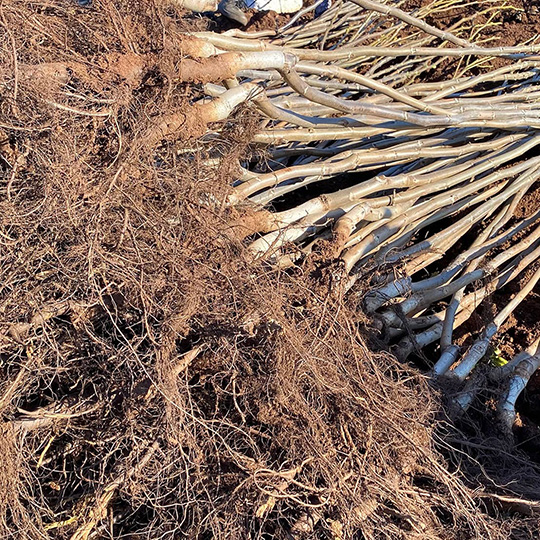
We are the largest producer of walnut trees in Europe. Our production fields are located in Turkey but we export our trees to all countries.
Robert Livermore is a specialty variety and we produce it in smaller quantities than our mainstream varieties, so if you are planning a Robert Livermore block please contact us early. That lets us reserve the trees and, if the quantity is large, graft to your order for the following season.
We send the young walnut trees bare rooted and dormant (in winter sleep). Our shipping season runs through the winter months, from November to April. We have phytosanitary certificates for all of our tree varieties, issued by the Turkish Ministry of Agriculture.
How to store your trees before planting: Choose a location that doesn't take much wind, it can be inside or outdoors. It is important that you store them somewhere preferably between 0 and 8 degrees celcius so that trees don't wake up from their winter sleep. Bury the roots of the trees in sand or soil and keep them like that until you plant them.
FREQUENTLY ASKED QUESTIONS
WALNUT TREE PRICES
Fill out a quick form and we can send you a price list in 24 hours.